
Un corpo estraneo | An alien body — Reflections on the Work of Art in the Contemporary
Alcune riflessioni sul significato profondo dell’opera d’arte nel contemporaneo.
Questo testo riprende un passaggio del saggio “Un corpo estraneo”, scritto dalla curatrice e critica d’arte Roberta Bertozzi e pubblicato nel 2018 in un catalogo realizzato dalla Galleria Gasparelli Arte Contemporanea di Fano.
Some reflections on the profound meaning of the work of art in the contemporary.
This text revisits an excerpt from the essay “An Alien Body” by curator and art critic Roberta Bertozzi, originally published in 2018 in a catalogue produced by Galleria Gasparelli Arte Contemporanea, Fano.
“Il perfetto”, scriveva Nietzsche, “deve non essere divenuto”. Con successiva postilla commentava Theodor W. Adorno nei suoi Minima Moralia: “deve apparire cioè come se non fosse stato fatto”. Se prestiamo fede a queste tesi, l’aura di un’opera d’arte, il suo perfectum, dipenderebbe dal suo istituirsi come un qualcosa di completamente irrelato dal tempo – scisso da un pre e da un post, da ogni condizione del “fare”, dunque da tutto quell’insieme processuale della concezione, della fabbricazione, dell’esibizione e dell’attribuzione di un valore cui di solito è soggetta qualsiasi manifattura, non solo quella artistica.
La perfezione di un’opera consisterebbe nel suo consegnarsi, fin dal principio, all’oblio di ogni contingenza. Assestandosi solo come un fenomeno di natura, entità chiusa entro il suo perimetro, in tale perimetro completa e autosufficiente. Una pura e semplice oggettivazione, scevra di tutti quegli ipotetici impulsi che avrebbero concorso alla sua realizzazione. Un datum, nulla più.
“The perfect,” wrote Friedrich Nietzsche, “must not have become.” With a later gloss, Theodor W. Adorno observed in Minima Moralia: it must appear “as if it had not been made.” If we take these theses seriously, the aura of a work of art—its perfectum—would depend on its ability to institute itself as something entirely unrelated to time: severed from a before and an after, from any condition of making, and thus from the whole procedural constellation of conception, fabrication, exhibition, and attribution of value to which any form of manufacture—not only artistic production—is normally subject.
The perfection of a work would therefore consist in its surrender, from the very beginning, to the oblivion of contingency. It would settle as a phenomenon of nature, an entity closed within its own perimeter—complete and self-sufficient within that boundary. A pure objectification, free from all those hypothetical impulses that may have contributed to its realization. A datum, nothing more.

L’opera d’arte agisce alla stessa stregua di un corpo estraneo, di uno strappo nella consuetudine del nostro vedere, di una cesura nella continuità del percepibile. In essa coabitano due forze, due vettori speculari: il primo di altitudine, di sradicamento, quasi conformandosi a una specie di ultimatum; il secondo di gravità, di ritorno a una qualche, perduta e mai più riscattabile, origine.
A work of art operates much like a foreign body—an interruption in the habit of our seeing, a rupture in the continuity of the perceptible. Within it, two forces coexist, two mirrored vectors: the first tending toward elevation, toward uprooting, almost as if issuing a kind of ultimatum; the second tending toward gravity, a pull back toward some lost origin, one that can never truly be recovered.
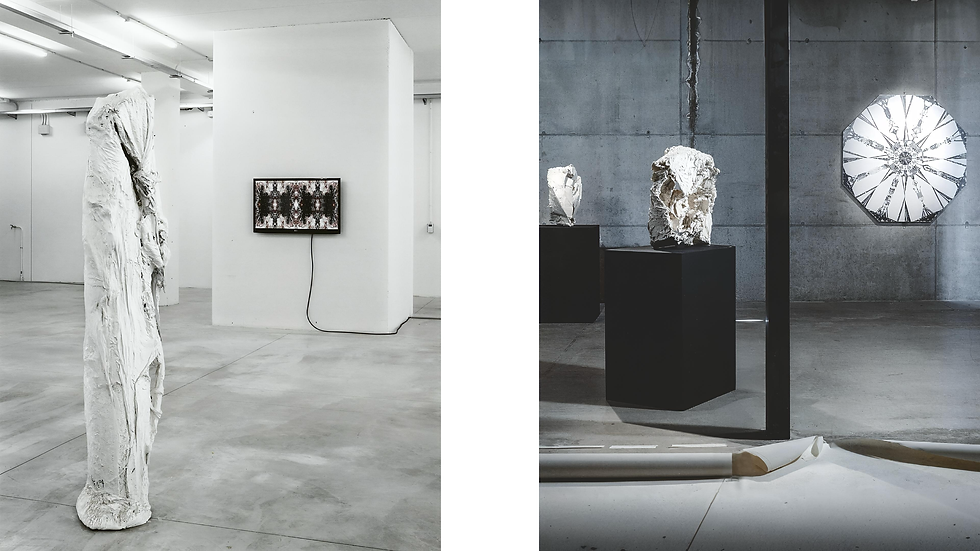
Ciò che è in gioco è esclusivamente l’individuazione di quel punto di vista capace di rendere questa contrapposizione di forze ancora più oggettiva, più radicale: quel punctum da cui è possibile esasperare la solitudine dell’opera, l’opera nella sua solitudine, sorta di monade che proprio in quanto non ha più nulla a che fare con noi – né con chi ne ha favorito l’emersione né con chi si trova al suo cospetto – ci interroga dal lato della sua presenza, del suo scandalo.
Forse il compito del curatore o del critico non consiste in altro che nel mostrare, nel rendere visibile questo attrito e le sue virtualità. Nell’accordare spazio a ciò che aspira a farsi atto, anche e soprattutto quando questa volontà si condensa e si singolarizza indipendentemente da noi.
What is at stake is the identification of that vantage point capable of rendering this opposition of forces even more objective, more radical: that punctum from which the solitude of the work can be intensified—the work in its solitude, a kind of monad that, precisely because it no longer has anything to do with us, neither with those who enabled its emergence nor with those who stand before it, questions us from the side of its presence, from the side of its scandal.
Perhaps the task of the curator or critic is nothing other than to reveal this friction, to make it visible together with its latent possibilities—to grant space to what aspires to become an act, even and especially when this will condenses and takes form independently of us.
Roberta Bertozzi
Un corpo estraneo ⎢An Alien Body
riflessioni sull’opera d’arte nel contemporaneo
notes on the work of art in the contemporary
Excerpt from a critical essay by Roberta Bertozzi, originally published in 2018 in a catalogue produced by Galleria Gasparelli Arte Contemporanea, Fano.
IG roberta_artview ↗︎


Commenti