
La superficie ruvida delle cose | The rough surface of things
Nel 2015 Roberta Bertozzi firmava il saggio critico per una mostra dedicata a quattro ricerche accomunate da una stessa tensione: attraversare la parte meno pacificata del visibile. A distanza di tempo, quel testo torna come una riflessione ancora attuale sull’impurità e l’instabilità dell’immagine. Non una celebrazione della forma levigata, ma un’indagine sulla superficie ruvida delle cose.
In 2015, Roberta Bertozzi wrote the critical essay for an exhibition devoted to four practices united by a single tension: that of traversing the least pacified part of the visible. Some years on, that text returns as a reflection that remains strikingly current on the impurity and instability of the image. Not a celebration of the polished form, but an inquiry into the rough surface of things.
Oltre la levigatezza, la pianificazione, l'omologazione che dominano l'estetica contemporanea, l'opera di questi artisti testimonia come l'arte possa essere ancora il luogo dove permangono l'impurità e il residuo, come traccia concreta della vita in tutte le sue folte, brulicanti, irriducibili sfaccettature. Difficile è attraversare questo Unheimliche, il perturbante, la spigolosa alterità delle cose; difficile restituirne il peso specifico, ammettendone le sbavature, le imperfezioni, il disagio, includendo anzi tutti questi elementi come parti inalienabili della sua manifestazione. [...]
Beyond the smoothness, the planning, the homologation that dominate contemporary aesthetics, the work of these artists testifies to how art can still be the place where impurity and residue persist, as concrete traces of life in all its dense, teeming, irreducible facets. Difficult is crossing this Unheimliche, the uncanny, the jagged otherness of things; difficult is restoring its specific weight, admitting the smudges, the imperfections, the unease, including all these elements as inalienable parts of its manifestation. [...]

Massimiliano Fabbri
Massimiliano Fabbri si lascia irretire dall'intrico, assecondando il gorgo di una vegetazione formale pervasiva, labirintica, insolubile. Nella pratica, il suo gesto procede per assemblaggi di carte, con una impercettibile gerarchizzazione dei piani mediante incastro, sfruttandone il precario margine d'innesto per far proliferare ulteriori linee e sezioni, secondo quella ritmografia automatica e germinativa che appartiene al disegno. In questa progressiva stratificazione, nel groviglio di steli, radici, fogliami, atto a simulare l'intrinseca perversione dell'ordo naturalis, lo spazio tende a occludersi, a flettersi verso l'interno, suggerendo una sorta di movimento a spirale diretto verso un ipotetico fulcro generativo. L'entropia della natura sembra così rispondere a un segreto ordine, di cui ogni proiezione grafica rappresenta l'ideale e necessario adempimento. [...]
Massimiliano Fabbri lets himself be ensnared by the entanglement, yielding to the whirl of a formal vegetation that is pervasive, labyrinthine, insoluble. In practice, his gesture proceeds through assemblages of paper, with an imperceptible hierarchization of planes through interlocking, exploiting their precarious margin of grafting to proliferate further lines and sections, according to that automatic and germinative rhythmography that belongs to drawing. In this progressive stratification, in the tangle of stems, roots, foliage, meant to simulate the intrinsic perversion of the ordo naturalis, space tends to occlude itself, to bend inward, suggesting a kind of spiral movement directed toward a hypothetical generative fulcrum. The entropy of nature thus seems to answer to a secret order, of which every graphic projection represents the ideal and necessary fulfillment. [...]
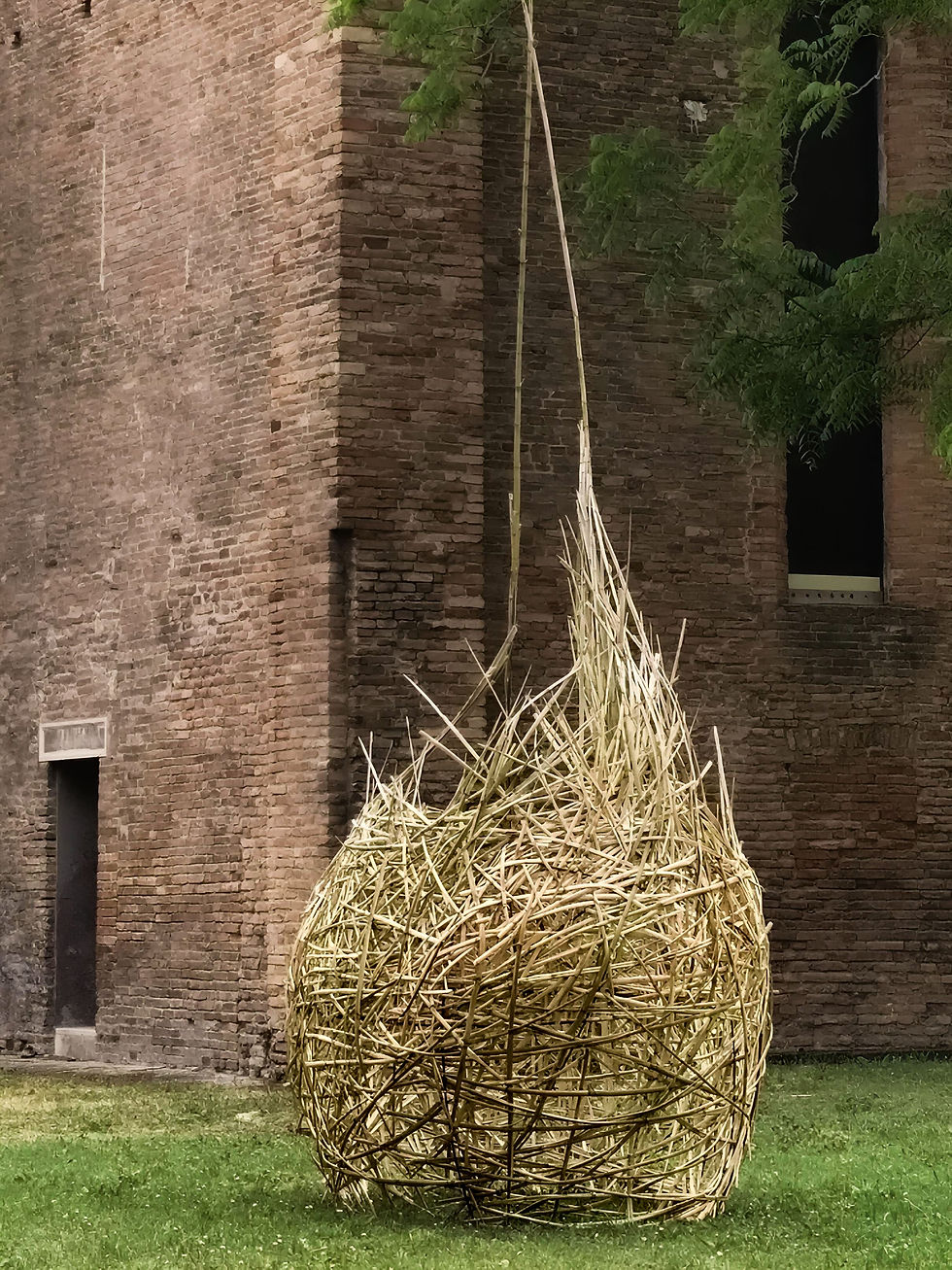
Oscar Dominguez
Pur partendo dallo stesso concetto di intrico, Oscar Dominguez sposta l'asse sul carattere dinamico di questa conformazione spaziale e sulle potenzialità che gli sono sottese. Nelle sue installazioni si assiste a una specie di torsione, di stiratura della materia, a una messa in rilievo delle sue articolazioni e nervature come canali di propagazione del suo quantum energetico. L'impressione di mobilità deriva proprio dal procedimento adottato dall'artista: l'oggetto (un albero, un animale, una forma) viene sfibrato, diradato; sul suo volume si aprono dei varchi, delle aree vuote, con la volontà di far emergere una specifica pulsione dell'indifferenziato. Ciò che ne consegue sono delle immagini metonimiche di una realtà di cui resta soltanto il telaio, lo scheletro, la struttura molecolare, dove l'anima interiore è, per così dire, rovesciata, completamente esposta in superficie. [...]
Though starting from the same concept of entanglement, Oscar Dominguez shifts the axis toward the dynamic character of this spatial conformation and the potentialities underlying it. In his installations one witnesses a kind of torsion, a stretching of matter, a bringing into relief of its articulations and veins as channels for the propagation of its energetic quantum. The impression of mobility derives precisely from the procedure adopted by the artist: the object (a tree, an animal, a form) is unfibered, thinned out; on its volume gaps open, empty areas, with the will to bring forth a specific pulsion of the undifferentiated. What follows are metonymic images of a reality of which only the frame, the skeleton, the molecular structure remains, where the inner soul is, so to speak, turned inside out, completely exposed on the surface. [...]

Domenico Grenci
È sintomatico che la ricerca di Grenci muova dall'immagine patinata, e dunque stereotipata, per effettuare quella che definirei una erosione, ma sarebbe meglio dire ossidazione, della sua datità rappresentativa. Il soggetto privilegiato su cui egli interviene al fine di sconcertarne il postulato iconico sono busti e volti femminili, la staticità espressiva, trasfigurandoli, spostandoli in quella zona incerta che sta tra presenza e assenza. Per mezzo di perimetrate liquefazioni, accumuli e scalfitture, secondo una giustizia chiaroscurale che trova nell'impiego del bitume il suo rinforzo, quella che è l'integrità del soggetto viene diluita, resa flou, riportando così in luce tutte le personalità parziali, erronee, transitive che da esso possono scaturire. È in forza di questa fugacità, di questa tensione sulla soglia di un essere o di un poter-essere-altrimenti, che la persona si attesta. [...]
It is symptomatic that Grenci's research moves from the polished, and therefore stereotyped, image, in order to effect what I would call an erosion, though oxidation would be the better word, of its representative givenness. The privileged subject on which he intervenes, in order to unsettle its iconic postulate, is female busts and faces, expressive stasis, transfiguring them, shifting them into that uncertain zone lying between presence and absence. By means of bounded liquefactions, accumulations and scratches, according to a chiaroscuro justice that finds its reinforcement in the use of bitumen, the subject's integrity is diluted, rendered flou, thereby bringing back to light all the partial, erroneous, transitive personalities that may spring from it. It is by force of this fleetingness, this tension on the threshold of a being or a could-be-otherwise, that the person attests itself. [...]

Stefano Ricci ci mette a confronto col fatto che l'identità non è soltanto la somma dei tratti fisionomici o caratteriali di un individuo, ma che in ogni vita si trova un tema, una traiettoria, un impulso, qualcosa che lotta per realizzarsi, esattamente come in un dramma. L'impianto delle sue tavole, la cui notazione numerica ricorda da vicino gli storyboard, è narrativo; la cattura della visione avviene sempre in un tracciato gestuale e i soggetti possiedono attributi da dramatis personae. Più che alla identificazione analitica di questi personaggi, Ricci sembra intento a restituire la loro tonalità sensibile ed emotiva, comunicando, nella sospesa enigmaticità di azioni e posture, un che di immediato e vivido, amplificato dalla cornice circostante, dalla temperatura cromatica e dal modello atmosferico dell'insieme. [...]
Stefano Ricci confronts us with the fact that identity is not merely the sum of an individual's physiognomic or characterial traits, but that in every life there lies a theme, a trajectory, an impulse, something that struggles to fulfill itself, exactly as in a drama. The layout of his tableaux, whose numerical notation closely recalls storyboards, is narrative; the capture of vision always occurs within a gestural framework, and the subjects possess attributes of dramatis personae. More than to the analytical identification of these figures, Ricci seems intent on rendering their sensible and emotional tonality, communicating, in the suspended enigmaticity of actions and postures, something immediate and vivid, amplified by the surrounding frame, by the chromatic temperature, and by the atmospheric model of the whole. [...]
Sarebbe riduttivo rilegare sotto un comune denominatore le sintassi compositive di questi artisti. Eppure sembrano ugualmente condividere un'insolita affinità. Essa risiede nel medesimo tentativo di accogliere ed evidenziare il lato resiliente, caotico, non conforme di ciò che si offre alla vista, quella superficie ruvida della realtà delle cose, che domanda sempre, per essere riconosciuta, uno sguardo capace di altrettanta divergenza, uno sguardo altro.
It would be reductive to bind under a common denominator the compositional syntaxes of these artists. And yet they seem to share an unusual affinity all the same. It lies in the same attempt to welcome and bring out the resilient, chaotic, nonconforming side of what presents itself to sight, that rough surface of the reality of things, which always demands, in order to be recognized, a gaze capable of an equal divergence, an other gaze.
Roberta Bertozzi
The rough surface of things
Beyond the aesthetics of perfection, four artists interrogate the chaotic, unstable, and irreducible part of the visible.
Russi, September 12–27, 2015
Curated by Roberta Bertozzi
Exhibition itinerary
Ex Chiesa in Albis, Piazza Farini — Domenico Grenci | Biblioteca Comunale, Via Godo Vecchia — Stefano Ricci | Torrioni, Piazza Baccarini and Via Babini — Oscar Dominguez | Rocca del Castello, Via Don Minzoni — Massimiliano Fabbri
IG roberta_artview ↗︎


Commenti