
Quando l’arte diventa struttura | When art becomes structure
Ogni incontro con un’opera non è mai neutro: è una frizione.
Ci sono lavori che si offrono allo sguardo e lavori che, invece, impongono il proprio spazio — definiscono una soglia, un margine. A partire da qui, nasce una delle mie selezioni da ArtVerona 2025: opere che non rappresentano, ma strutturano.
Every encounter with an artwork is never neutral: it’s a friction.
Some works offer themselves to the gaze, while others impose their space — defining a threshold, a margin. From here emerges one of my selections from ArtVerona 2025: works that do not represent but structure.
Non esiste un “materiale” fuori dalla forma: ciò che chiamiamo materiale è già formale. Per questo la forma non riveste: decide — istituisce margini, ordina le relazioni, dà necessità a ciò che appare.. La forma non è un involucro ma una pressione interna: non accompagna il contenuto, lo genera.
Visitando lo stand di Mazzoleni ad ArtVerona 2025, nell’incontro con le opere di Nunzio e Salvatore Astore, questa percezione si fa ancora più intensa: è il modo stesso in cui le opere abitano lo spazio e ne impongono l’assetto — costringendolo a rispondere — a produrre tensione. Nessuna cornice neutra: ogni elemento agisce entro un regime di vincoli che definisce soglie e margini.
There is no “material” outside form: what we call material is already formal. Hence form does not clothe; it decides — it institutes margins, orders relations, and confers necessity on what appears. Form is not a wrapper but an inner pressure: it does not accompany content; it generates it.
Visiting the Mazzoleni booth at ArtVerona 2025, in the encounter with works by Nunzio and Salvatore Astore, this perception sharpens further: it is the very way the works inhabit space and impose its set-up — forcing it to respond — that produces tension. No neutral frame: each element operates within a regime of constraints that defines thresholds and margins.
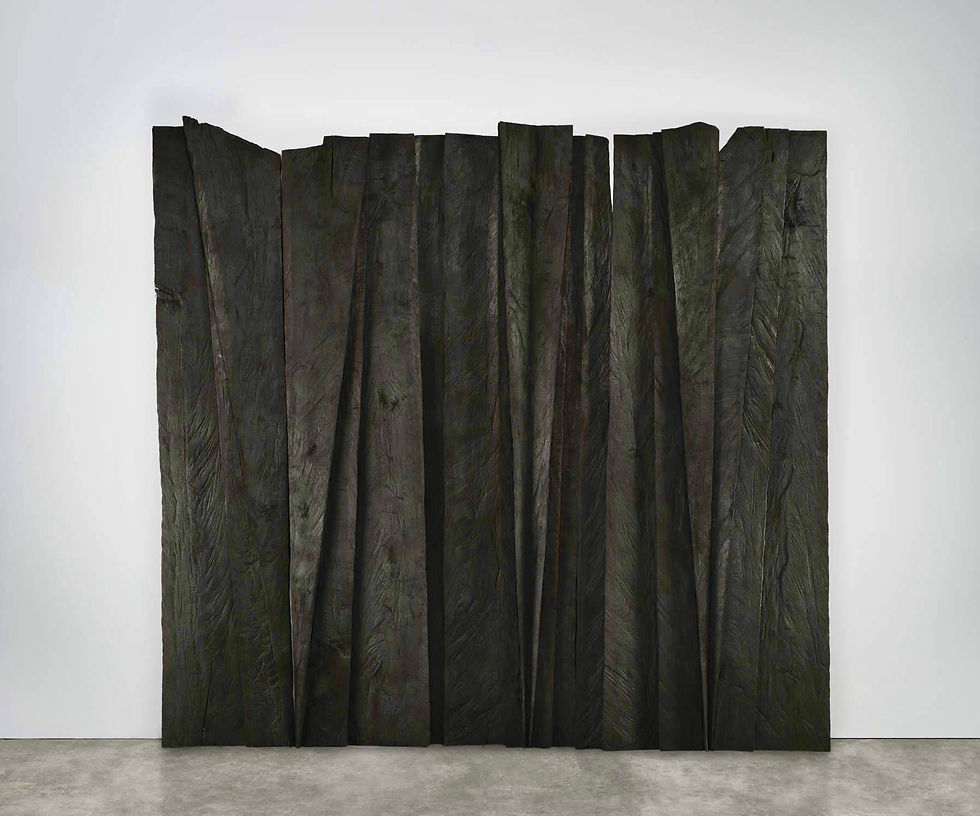
Nunzio, L’Aperto (1987; combustione su legno, 275 x 300 x 8 cm). Foto: Agostino Osio
L’opera d’arte agisce alla stessa stregua di un corpo estraneo, di uno strappo nella consuetudine del nostro vedere, di una cesura nella continuità del percepibile. In essa coabitano due forze, due vettori speculari: il primo di altitudine, di sradicamento, quasi conformandosi a una specie di ultimatum; il secondo di gravità, di ritorno a una qualche, perduta e mai più riscattabile, origine.
The work of art acts in the same way as an alien body, a tear in the habit of our seeing, a break in the continuity of the perceptible. Two forces coexist in it, two mirror vectors: the first of altitude, of uprooting, almost conforming to a kind of ultimatum; the second of gravity, of returning to some, lost and never redeemable, origin.

Salvatore Astore, Gli occhi della scultura - Photo by Renato Ghiazza
Se Nunzio, attraverso le combustioni, lascia che la reazione del calore scriva sul legno — e le pieghe, gli annerimenti restano come tracce termiche, indici di processo più che effetti visivi — Astore sposta il discorso sulla tenuta strutturale: l’acciaio satinato non occupa lo spazio, lo ancora; piani e giunzioni restano leggibili, le cordonature funzionano come articolazioni.
In entrambi i casi non c’è illustrazione ma indagine sulla plasticità della forma: non un tema da rivestire, ma una costruzione che mette alla prova margine, asse, continuità. È qui che maturano forme nuove e autentiche, inscritte nella logica delle strutture organiche — dove crescita, compressione, sutura e taglio trovano un equilibrio operativo.
Combustione e saldatura, disegno e giunto, convergono così in uno stesso gesto: dare forma che regge.
If Nunzio, through combustion, lets the reaction of heat write on lead — with folds and darkening remaining as thermal traces, indices of process rather than visual effects — Astore shifts the argument to structural bearing: satin steel does not occupy space; it anchors it. Planes and joints remain legible; weld beads function as articulations.
In both cases there is no illustration but an inquiry into the plasticity of form: not a theme to be clad, but a construction that tests edge, axis, continuity. Here new and authentic forms take shape, inscribed within the logic of organic structures — where growth, compression, suture and cut find an operational equilibrium.
Combustion and welding, drawing and joint, thus converge in a single gesture: to give form that holds.
Roberta Bertozzi
Quando l’arte diventa struttura ⎢When Art Becomes Structure
Una geometria sotto pressione.
One Geometry Under Pressure.
Note sull'opera di Nunzio e Salvatore Astore
Notes on the work of Nunzio and Salvatore Astore
Testo di Roberta Bertozzi | Text by Roberta Bertozzi
This article expands the Instagram caption posted on 18 October 2025.
IG roberta_artview ↗︎


Commenti